Alberta opportunity for AI adoption takes the stage at Upper Bound
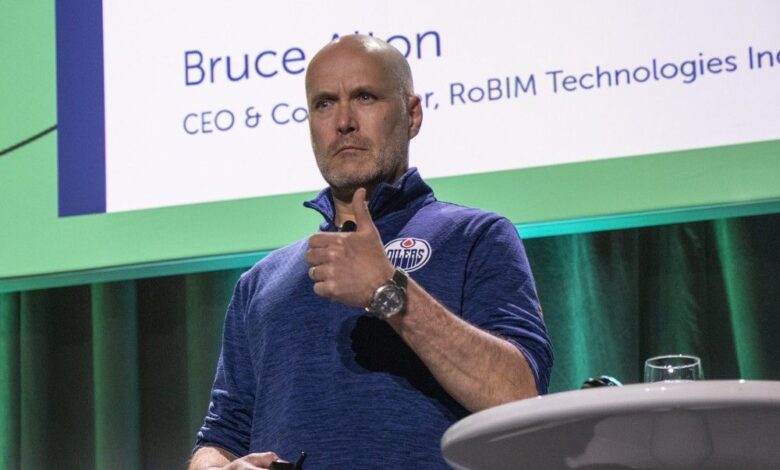
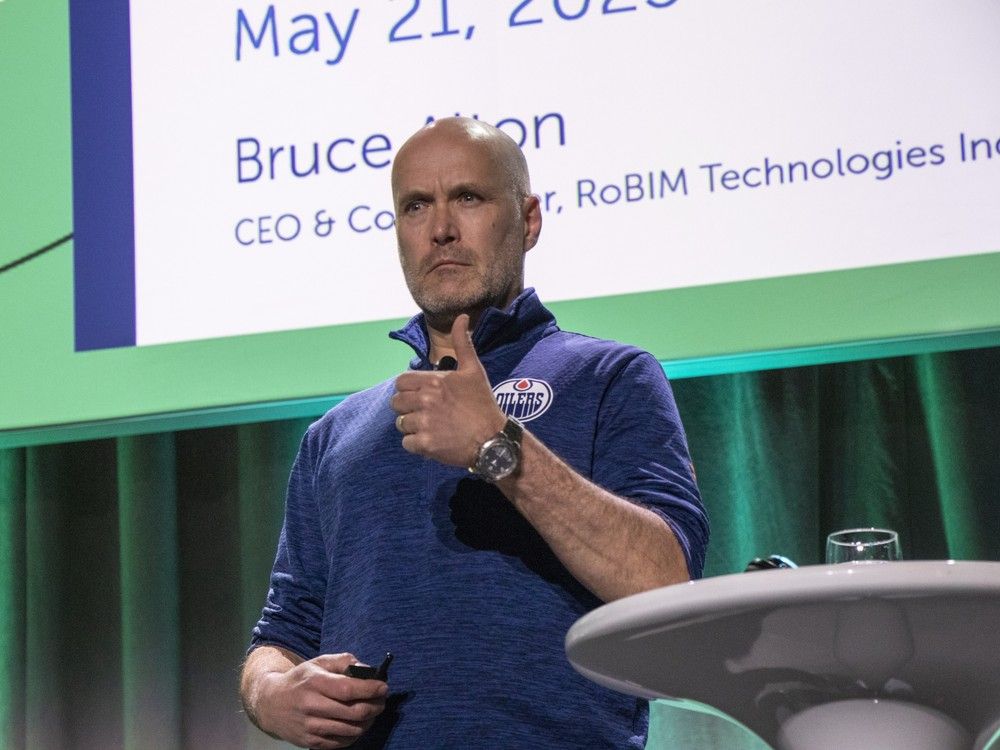
Edmonton may be the best-positioned city in the country to seize on the growth of AI’s applications in construction.
“If you’re a business person or a technologist or someone in between, you really want to focus on an area that’s got growth and opportunity. This is it,” said
RoBIM Technologies Inc.
CEO and co-founder Bruce Alton.
“Edmonton and Alberta is a place to do it. We have the opportunity here to be global leaders in construction, AI and robotics.”
Presenting to a crowd of headphone-clad listeners at the Upper Bound AI convention on Wednesday afternoon, Alton made the case that Alberta, and specifically Edmonton, is primed to capitalize on the growing demand for AI and robotics in construction. Pointing to lagging productivity in the industry, he argued that the marriage of the oldest and largest industry in the world (construction) with the newest and biggest growing industry (AI) was paramount to the future
—
especially as the country tries to make up ground in a housing shortage crisis.
“As it turns out, we’re at an inflection point. There are a number of things that we’re seeing in (RoBIM’s) area, but also related to a number of other construction companies,” Alton said.
RoBIM is an Edmonton-based technology company that offers “
end-to-end robotic fabrication solutions for the residential and commercial construction industries,” giving Alton a practical perspective on the needs and opportunities in the industry. He said the industry’s productivity, by comparison to other industries like agriculture, has been stagnant over the past several decades, according to data from McKinsey & Company.
“Zero productivity growth over the last 75 years. It’s crazy. And if you kind of look back for the last 40 years, maybe since 1980, it’s actually been negative. So we’re actually getting worse at construction over the last many, many years,” said Alton.
Alton argued that a lack of automation and robotics played a key role in the lagging productivity in the industry, saying
there are six different areas where AI could improve the industry — design and planning; project costing and scheduling; operating efficiency; monitoring and inspection; training and safety; and robotics and automation.
The latter is what RoBIM focuses on, creating robots that can assist with pre-fabricated construction, which is set to have a full commercial launch next year.
He said that part of the company’s success, which is also what he recommended to prospective entrepreneurs in the room, is that it bears in mind three important elements of business and innovation. According to Alton, you need a big market with a big problem to solve, disruptive technology, and domain and subject matter expertise, all of which lead to startups, investment, and research money.
In the case of RoBIM, the market was Edmonton, Alberta and Canada and the problem was lagging productivity in construction. The disruptive technology was using robotics to automate elements of construction, and the subject matter expertise comes from the many AI experts and construction companies that are based in the city, such as AMII, the University of Alberta for AI and Stantec, Ellis Don, and PCL for construction.
As the new Liberal government contends with a challenging housing crisis, Alton highlighted that the issue presents a big problem with a large market for solutions, which could be a valuable opportunity for upcoming entrepreneurs. With the same local pool of AI and construction experts as RoBIM, he said the timing is “perfect.”
“I wanted to highlight this because I really feel now, 2025, this is really a unique opportunity to be in this space,” said Alton.
“I want to leave you with a challenge, ‘How are you going to get involved? What are you going to do in this space overall?’”
zdelaney@postmedia.com